Cordless Pressure Washer — 21V Battery, Draws From Any Bucket
Normalpreis
€43,94

No tap, no cord, no extension lead
That is the whole reason to own it. A plug-in washer ties you to an outside tap and a power socket, which rules out a flat with no garden, a car parked on the street, a boat on a trailer or a campsite. This one runs off a 21V lithium battery and draws its own water through an intake hose you drop into a bucket, a barrel, a water butt or a lake. Fill the bucket, drop the hose in, pull the trigger.


Self-priming
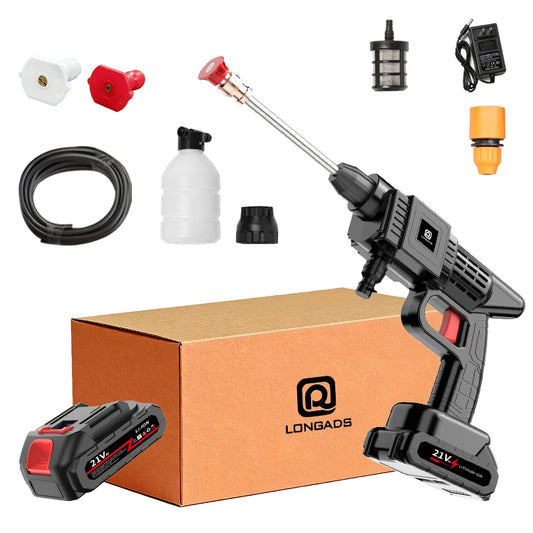
The pump primes itself, so the water source can sit lower than the gun. The intake hose has an inline mesh filter on the end that sits in the water — that filter is what lets you use a rain barrel or a lake without shredding the pump on grit.
If you do have a tap, there is an orange quick-connect adaptor in the box that clips onto a standard garden hose fitting. Either way works. The bucket is the point; the tap is the fallback.

Read this bit properly
The maximum is 30 bar, about 435 PSI. A typical household tap sits around 3–4 bar, so this is a real step up from rinsing with a hose. But a plug-in electric pressure washer runs four to five times harder, and we would rather you knew that now than found out on your driveway.
What 30 bar is good at: road film off paintwork, mud out of wheel arches, bird mess off a deck, dust off patio furniture, salt off a bike, a muddy dog. What it is not good at is ground-in concrete stains and flaking paint. The nozzle itself is copper, twist-adjustable from a tight jet to a wide fan.


Foam bottle included
Swap the lance for the soap bottle, fill it with car shampoo and it lays down a thick foam. Let the foam sit for a couple of minutes and it lifts the grit off the paint so you are rinsing dirt away rather than dragging it around with a sponge.
Then twist the bottle off, put the lance back on and rinse. Two attachments, one tool, no bucket-and-sponge swirl marks.

In the hand
It is a pistol grip with a finger trigger and the battery slides into the base of the handle like a cordless drill. The body is engineering plastic with an alloy connector at the nozzle end, and the whole thing weighs 1.6 kg (3.5 lb) as shipped, battery included.
Water only flows while you hold the trigger, so there is nothing to switch off and nothing left running. The battery pops out with the red catch and charges on the mains adaptor in the box.
Three things we will not repeat from the manufacturer
Runtime. The supplier's own listing says 60 minutes on a full charge. The cell it ships is 21V, 1500 mAh — about 31 watt-hours. That is not enough energy to drive a pump for an hour of continuous spraying, so we are not printing the number. Plan around water instead of minutes: a bucket at a time, with the trigger going on and off, is the honest way to think about it.
How many batteries. The package specification for this variant reads washer + 1 battery. Some of the manufacturer's photography shows two. Assume one battery and one charger. If two turn up, that is a bonus, not a promise we made.
Water rating. There is no IP rating published for the tool or the battery. It is designed to be pointed at water, obviously, but treat the battery housing as splash-tolerant rather than sealed. Do not leave it out in the rain and do not submerge it.
Any of those a dealbreaker? Email support@lumoraloves.com before you order and we will put the question to the supplier.
Before you buy
In the box

Specifications
| Max pressure | 30 bar (about 435 PSI) |
| Power | 21V lithium-ion battery, 1500 mAh (about 31 Wh) |
| Water source | Self-priming from a bucket, barrel or lake · or a garden tap via the adaptor |
| Nozzle | Copper, twist-adjustable jet to fan · plus two clip-on tips |
| Body | Engineering plastic, alloy nozzle connector |
| Grip | Pistol grip, finger trigger — flows only while held |
| Charging | Mains adaptor included, 110–240 V |
| Weight | 1.6 kg (3.5 lb) as shipped |
| Runtime | Not published by us — see the note above |
| Water rating | None published — splash-tolerant, not sealed |
| In the box | Gun · extension lance · 2 clip-on nozzle tips · foam bottle · intake hose with mesh filter · garden tap adaptor · charger · 1 × 21V battery |
Good to know
Correct. Drop the intake hose into any open water — a bucket, a builder's tub, a water butt, the edge of a lake — and the pump lifts it. That is the main reason to choose this over a plug-in washer. If you have a tap and would rather use it, the orange adaptor in the box clips onto a standard garden hose fitting.
For a normal dirty car, yes — foam it, let it sit, rinse it. For caked-on winter mud in wheel arches you will be there a while, and you may want a second pass. If your yardstick is a petrol machine at the local car wash, this is not that.
We do not know and we are not going to print a figure we cannot stand behind. The supplier claims 60 minutes; the battery is 21V 1500 mAh, roughly 31 watt-hours, and that arithmetic does not support an hour of continuous spraying. Think in buckets rather than minutes, and buy a second battery if you want to keep going without stopping.
One, plus the charger. The supplier's photography sometimes shows two, which is why we are spelling it out here — the package specification for the variant we stock reads one.
No. It is a proprietary 21V pack with its own fitting. There are separate cordless washers built as attachments for the big tool platforms — if you already own that ecosystem, one of those is probably the better buy.
Yes — twist the nozzle to the widest fan and it works as a watering wand, which is handy on a balcony or an allotment with no tap. On the tight jet setting it will strip leaves off anything delicate, so open it up first.
Car shampoo and mild detergents, yes. Bleach, solvents and strong patio chemicals will attack the seals and the plastic bottle, and there is no chemical resistance data published for it. Stick to soap.
Run clean water through it for a few seconds to clear soap out of the line, then store it dry with the battery out. Water left in a pump through a hard frost is what kills these things.
Shipping & returns
Free standard shipping, no minimum. This one ships from a United States warehouse, so it moves faster than most of our catalogue: 1–3 business days to process, then 3–6 business days in the US. Tracking is emailed as soon as the parcel moves.
30-day returns. Items must be unused, in their original packaging and in the condition you received them, with proof of purchase. Email support@lumoraloves.com to start a return.
Lumora Loves
Home & lifestyle pieces chosen to make everyday jobs a little easier — and everyday living a little warmer.
Versand. Kostenloser Standardversand bei allen Bestellungen, ohne Mindestbestellwert. Bestellungen werden in 1–3 Werktagen bearbeitet, danach erhältst du eine Sendungsnummer per E-Mail. Die voraussichtliche Lieferzeit beträgt 3–6 Werktage in den USA und 7–10 Werktage international.
Rückgabe. Du hast ab Lieferung 30 Tage Zeit, eine Rücksendung anzumelden. Die Artikel müssen unbenutzt, in der Originalverpackung und im erhaltenen Zustand sein. Schreib mit deiner Bestellnummer an support@lumoraloves.com, dann schicken wir dir die Rücksendeanleitung — bitte schick nichts zurück, bevor du eine Rücksendung angemeldet hast. Dein gesetzliches Widerrufsrecht von 14 Tagen bleibt davon unberührt.
Beschädigt angekommen? Zerbrechliche Artikel können auf dem Transport leiden, prüf dein Paket also bei der Lieferung. Schick uns innerhalb von 48 Stunden ein Foto, dann ersetzen oder erstatten wir das Stück.
Alle Details: Versandrichtlinie und Erstattungsrichtlinie.
Nicht vergessen! Die Produkte, die du dir angesehen hast. Leg sie jetzt in den Warenkorb.
Hier sind einige unserer ähnlichsten Produkte, die gerade gekauft werden. Klick dich durch und entdecke, was gefragt ist.
Produkte sind nur solange verfügbar, wie der Vorrat reicht. Die Preise für den deutschen Markt verstehen sich in Euro und können sich ändern.
Alle Inhalte sind Eigentum von Lumora Loves.
Wir haften nicht für mittelbare Schäden aus der Nutzung der Produkte oder dieser Website. Die gesetzliche Haftung für Vorsatz und grobe Fahrlässigkeit sowie nach dem Produkthaftungsgesetz bleibt unberührt.